The Second Cane
A Mr. Jingles adventure · Illustrated story
Miss Tinsel stepped out of the shadows.
“Don’t press anything.”
Patch made a small, strangled noise.
Jingles spun around, raising his candy cane before recognizing her.
“Tinsel?”
She stood in the doorway, one paw still resting against the edge of the stone arch.
For a moment, nobody moved.
Then Patch looked from her to Jingles.
“You know her?”
“We’ve met,” Jingles replied.
Tinsel glanced at the candy cane pointed toward her.
“Usually under less threatening circumstances.”
Jingles lowered it slowly.
“How long have you been there?”
“Long enough to know that choosing a cookie because you like cookies isn’t a plan.”
Patch folded his arms.
“Thank you.”
Jingles ignored him.
His eyes stayed on Tinsel.
The mask. The princess gown. The familiar silver star against her chest.
Yesterday, he had been trying to think of reasons to see her again.
This was not one of them.
“Did you follow us?” Jingles asked.
Tinsel could have offered a clever answer.
She had several.
Instead, she nodded.
“Yes.”
The word settled heavily between them.
“Why?” Patch asked.
Tinsel looked beyond him toward the vault.
Then she made herself look back.
“Because I heard you talking about the time machine.”
Patch’s expression changed.
“At the restaurant?”
“Yes,” Tinsel replied.
Jingles remembered the questions outside the bakery. Old parts. Clockwork. Patch’s repairs.
Their accidental meeting.
His ears lowered slightly.
“Was bumping into me an accident?”
Tinsel hesitated.
“No,” she admitted.
Patch suddenly found a very interesting patch of floor to study.
Jingles looked away.
Tinsel had expected suspicion.
She found his disappointment harder to face.
“The pastries were real,” she said quietly.
Jingles glanced back.
“That wasn’t the part I was wondering about.”
“I know,” Tinsel replied.
For once, she had nothing clever to add.

A burst of laughter drifted faintly through the office.
All three turned toward the sound.
The party was still happening.
Santa was still downstairs.
And they were standing outside his vault, discussing a conversation that could go badly enough to last all evening.
Patch looked at the screen.
“Whatever this is,” he said, “we may have chosen a poor room for it.”
Tinsel nodded.
“I can help you understand the lock.”
“How?” Jingles asked.
She pointed above the vault.
“The banner.”
Patch leaned back.
Jingles followed his gaze.
Above them, embroidered shapes surrounded four empty stitched squares.
The same eight pictures as the screen.
Patch took two steps sideways, trying to see past the brass framework.
“Oh.”
Tinsel approached carefully, stopping beside them rather than reaching for the controls.
“The border,” she said. “Look at the little groups of marks.”
Patch studied the stitching.
Some marks sat inside small squares. Others curved around them. A third group lay outside both.
He looked down at the instructions on the screen.
“Correct place,” Patch murmured. “Correct symbol, different place. Not in the code.”
Tinsel nodded.
“It’s showing us how to read the results.”
Jingles examined the banner.
“So Santa has embroidered the instructions above the safe?”
“Apparently,” Patch replied.
“That feels surprisingly considerate.”
“It still doesn’t tell us the combination,” Tinsel said.
“No,” Patch agreed. “But it tells us how to learn it.”
He took a folded shopping receipt from his pocket.
Jingles stared.
“You brought homework?”
“A pencil,” Patch replied, finding it behind his ear. “And the receipt was already there.”
Tinsel moved closer.
Together, she and Patch divided the back of the paper into little columns.
Jingles watched them begin.
Then he glanced toward the office door.
For the moment, he would keep watch.
Their first guess earned a soft musical note.
Not the sound of an opening lock.
Four small result lights appeared.
Patch wrote down the totals.
Jingles leaned over his shoulder.
“Is that good?”
“It’s information,” Patch replied.
“Could the next information be that the door is open?”
Tinsel’s mouth twitched.
“Give us a moment.”
Patch drew a line through two possibilities.
Tinsel stopped his pencil before he crossed out a third.
“We don’t know that one is wrong,” she said. “We only know it isn’t right there.”
Patch considered the screen again.
Then he nodded.
“You’re right.”
Jingles looked between them.
It was strange, watching someone else understand Patch so quickly.
Usually, Patch explained a thing three times while Jingles found a way around it.
Tinsel seemed willing to stay with the explanation.
Their second guess changed the pattern.
Another little note.
Another set of totals.
One of the six lights went dark.
Then another.
Patch bent over the receipt.
Tinsel pointed to one of his columns.
“If that belongs, this one can’t.”
“Unless those two are reversed,” Patch replied.
They checked.
Jingles checked the door again.
Footsteps sounded somewhere beyond the office.
He raised a paw.
Patch’s pencil stopped.
Tinsel went still.
The footsteps approached.
Paused.
Someone outside laughed.
“Not that cupboard. The tablecloths are in the other one.”
A door opened.
Closed.
The footsteps faded.
For several seconds, Jingles could hear his own bell moving against his collar.
He held it still.
Patch slowly let out his breath.
“I would like,” Patch whispered, “to stop learning things about cupboards.”
“Work quickly,” Jingles replied.
Their third attempt brought them closer.
Patch stared at the result lights.
Then at the receipt.
Tinsel followed the pencil marks with one claw.
“Those two,” she whispered.
Patch nodded.
“Which leaves…”
He stopped.
Tinsel looked up at him.
They had reached the same answer.
Jingles recognized their expressions.
He had seen Patch look like that when the train wheel fitted.
When the breaker had worked.
When something that had existed only in his head finally made sense outside it.
“Have we got something?” Jingles asked.
Patch turned the receipt around.
Tinsel checked the screen one last time.
“I think so,” she replied.
Jingles looked at the three remaining lights.
Then at his new friend.
Then at the cat who had followed them here.
“Together?” he asked.
Patch nodded.
Tinsel’s paw hovered above the panel.
“Together,” she replied.
They entered the fourth arrangement.
For one terrible moment, nothing happened.
Then every result light shone gold.
Somewhere deep inside the wall, a bolt withdrew.
Another followed.
And another.
The vault wheel turned by itself.
Jingles stepped backward.
“Well,” he murmured, “that was considerably more work than a cookie.”
The enormous door began to open.
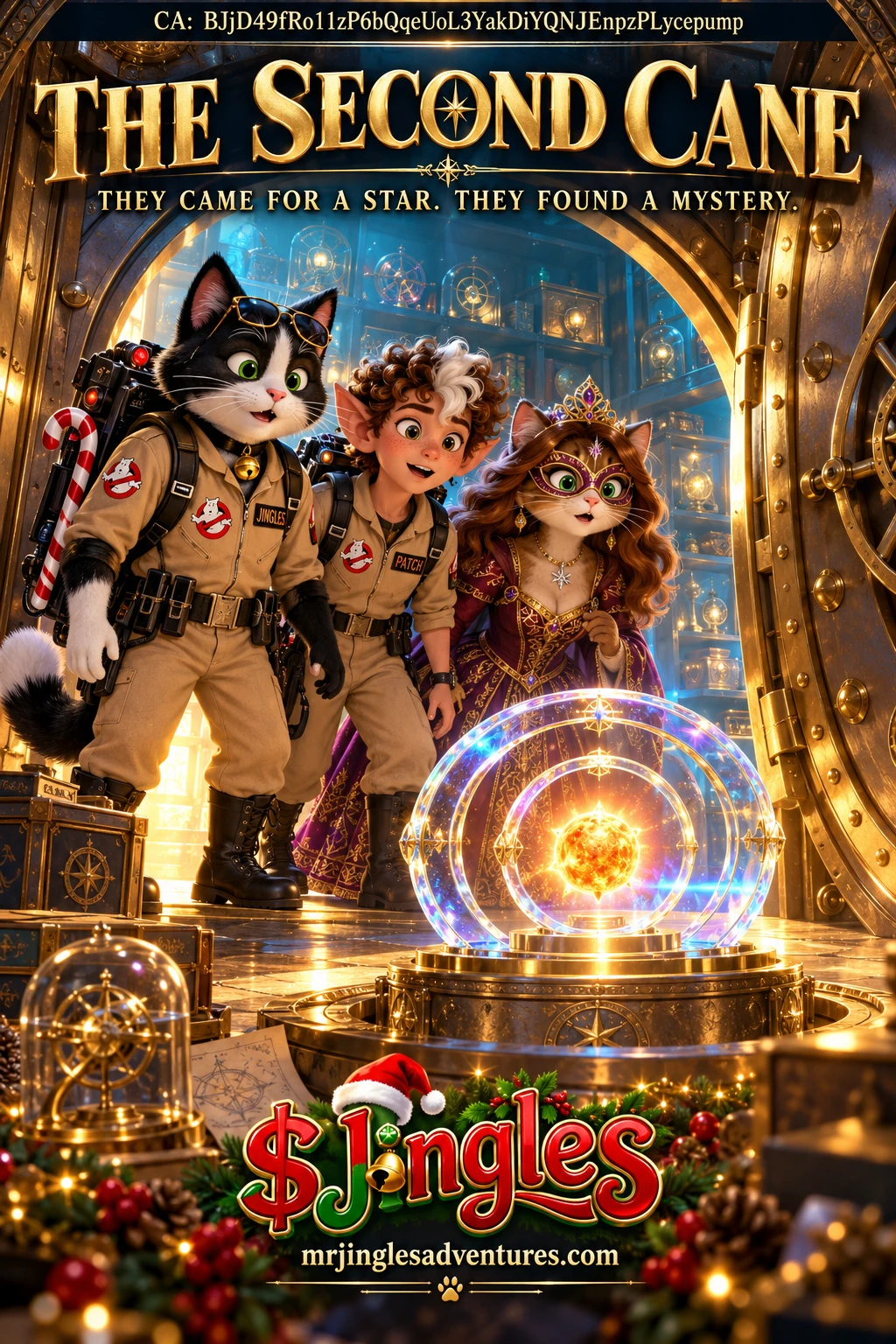
Golden light spilled across the floor.
The three stood shoulder to shoulder as the gap widened.
At the center of the vault floated the Starfall Core.
It was smaller than Jingles expected.
About the size of an orange, just as Patch had said.
Inside its crystal rings, a fragment of starlight turned slowly, shedding soft ribbons of gold and blue across the walls.
Patch forgot to breathe.
For years, he had built everything around an empty space.
Now the thing that belonged there hovered only a few steps away.
“That’s it,” Patch whispered.
Tinsel stared into the light.
Her father had once stood close enough to touch something like this.
He had understood it.
He had taken it.
She still didn’t know why.
Jingles stepped into the vault behind them.
The room contained more than the Core.
Shelves lined the curved walls. Old instruments rested beneath glass covers. Brass fittings, sealed boxes, and carefully wrapped mechanisms occupied neat rows.
Everything had a place.
Everything had been kept.
Then Jingles saw the cabinet behind the central pedestal.
He stopped so abruptly that Patch nearly walked into him.
“Jingles?”
Jingles didn’t answer.
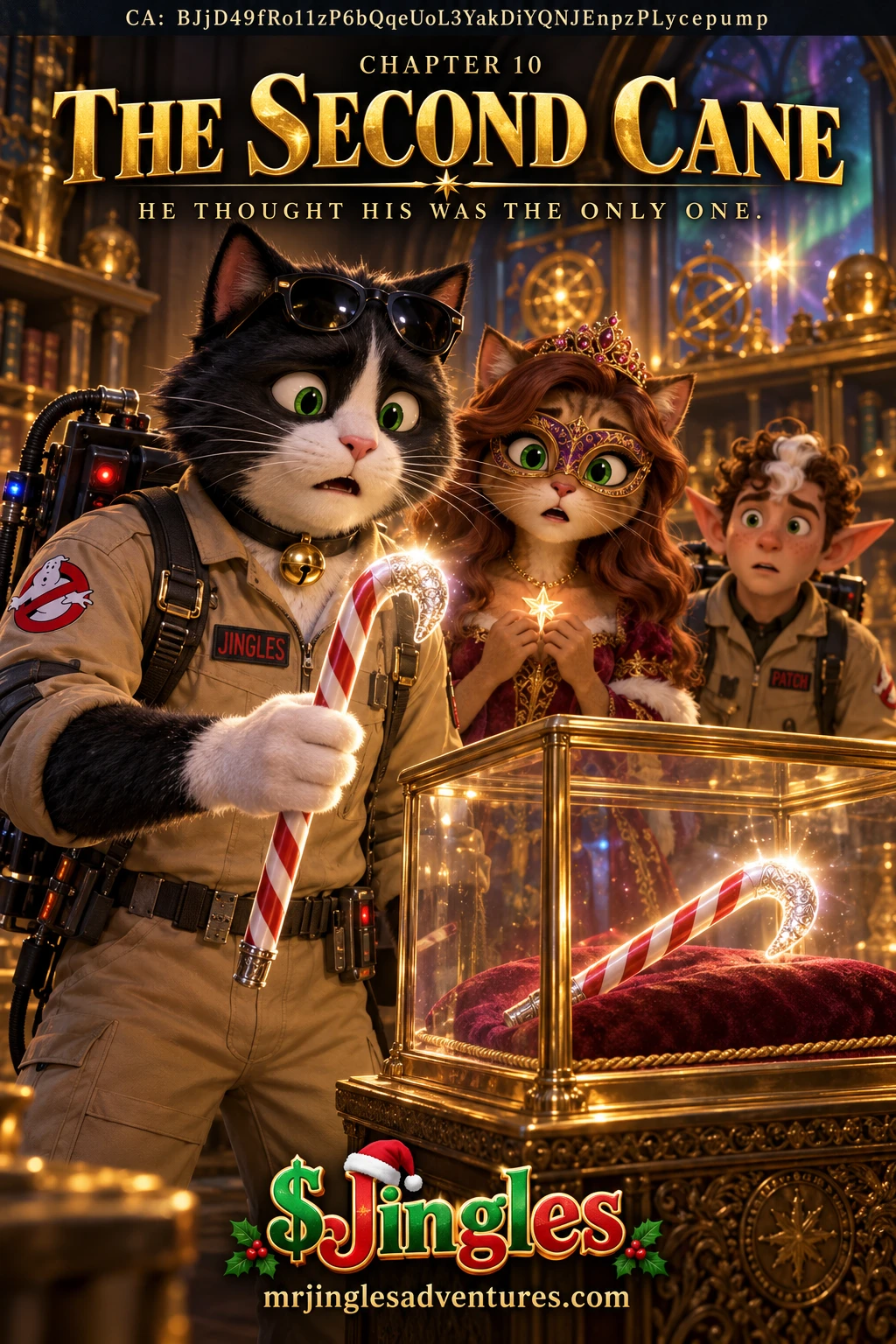
Inside the cabinet, on a bed of faded velvet, lay a candy cane.
Red stripes.
A gently curved handle.
A little silver tip.
Jingles looked down at the cane in his paw.
Then back at the one behind the glass.
They were identical.
Patch moved beside him.
“Oh,” Patch said softly.
It was the second time that evening he had used the word.
This time, it barely seemed large enough.
Jingles lifted his cane.
The silver tip brightened.
Inside the cabinet, the other cane answered.
A thin thread of white light travelled along its stripes.
Tinsel felt warmth against her chest.
She looked down.
Her star pendant was glowing.
Not reflecting the Core.
Glowing from within.
She caught it between her paws.
“Patch.”
He turned.
The light traced the small pattern on the back of her pendant.
Interlocking stars.
Patch’s eyes widened.
“That mark…”
“It was my father’s,” Tinsel said.
Jingles looked at her.
Tinsel swallowed.
“The brass housing in your machine has it too.”
Patch stared.
“How do you know what’s inside my machine?”
Tinsel met his eyes.
“I went into your apartment.”
The quiet in the vault changed.
Patch took a small step back.
“You did what?”
“I didn’t switch anything on,” Tinsel replied quickly. “I didn’t take anything. But I saw it. And I recognized his work.”
Jingles looked from her glowing pendant to the cabinet.
There were questions he wanted answered.
Several of them.
Before he could choose one, a ticking sound began behind the Core.
It came from a clock built into the far wall.
At first glance, it looked unfinished.
There were no ordinary numbers around its face.
Three dark glass windows sat beneath a ring of delicate moving hands.
Patch moved toward it slowly.
“I know this arrangement,” he murmured.
Tinsel followed his gaze.
Fine brass arms turned behind the glass. One moved forward while another travelled backward. Between them, a small ring held steady.
Patch reached toward the mechanism, then stopped before touching it.
“I’ve been building something like this.”
“In the machine?” Jingles asked.
Patch nodded.
“The timing assembly. I thought…”
He looked closer.
“I thought I was working out what the old pieces were meant to do.”
Tinsel studied the writing beneath the controls.
Her paw rose to her mouth.
Small, careful letters.
A crossed-out word.
An arrow squeezed into a space that was slightly too narrow.
She knew that handwriting.
“My dad built this,” Tinsel whispered.
The ticking grew louder.
One of the dark windows flickered.
Then all three filled with light.
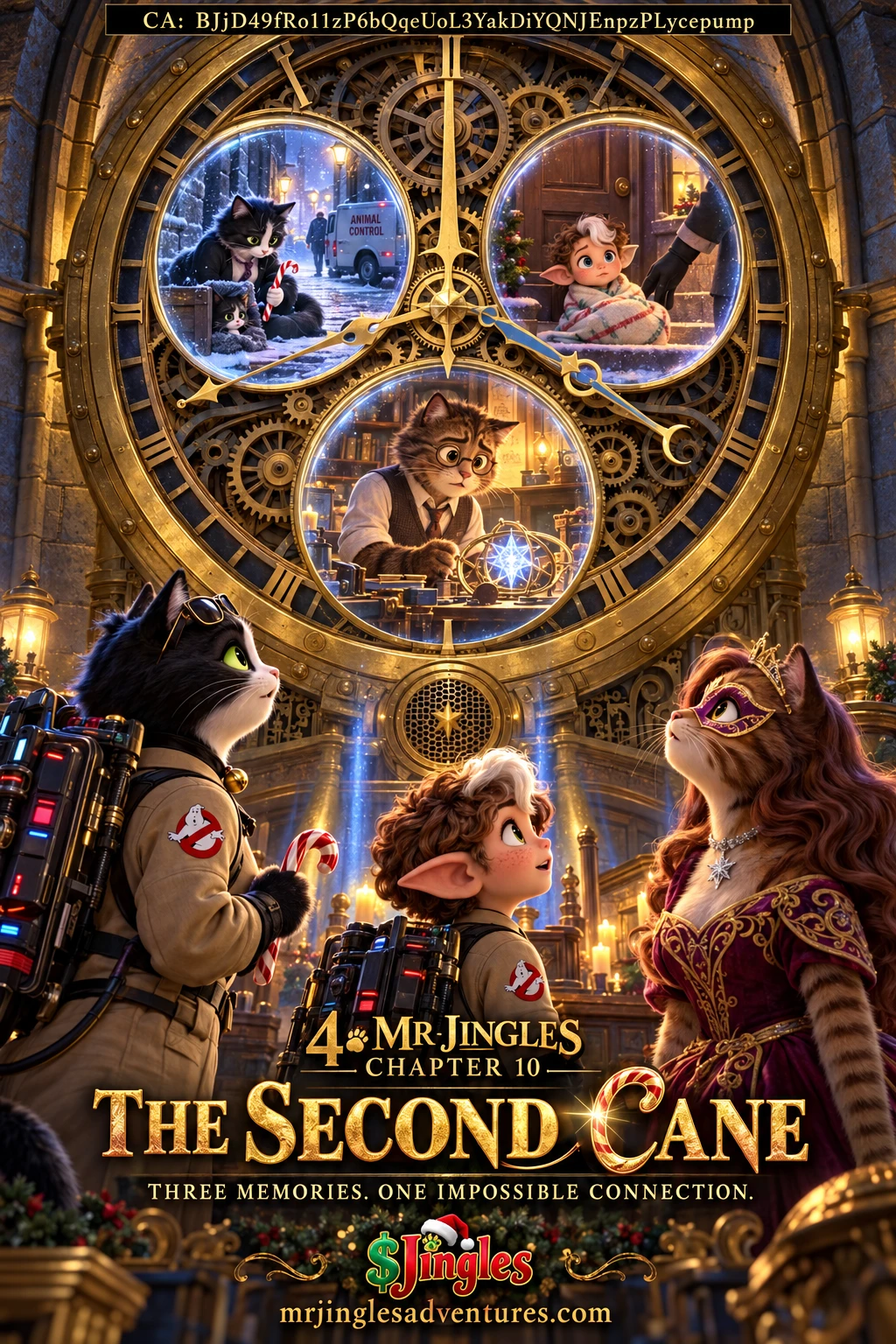
Jingles saw the alley first.
Snow.
A crate.
The corner of a vehicle turning into view.
His paw tightened around the cane.
“No,” he whispered.
He knew this place.
He knew this day.
Inside the first window, his mother bent beside the crate.
Her mouth moved.
Jingles could not hear the words, but he remembered them.
Stay where they can’t see you.
His knees weakened.
He had spent so long remembering that moment from beneath the crate.
Now he was looking at it from outside.
He could see her face.
The fear she had tried to keep out of her voice.
Then her gaze shifted toward someone beyond the edge of the image.
The picture trembled.
Beside it, the second window brightened.
Patch saw a doorway.
A blanket.
A very small elf with one ear folded against his head.
He moved closer until his breath clouded the glass.
“That’s me.”
A figure bent beside the blanket, mostly hidden by the narrow edge of the picture.
For an instant, a hand remained near the little elf’s face.
Then it withdrew.
Patch tried to lean far enough to see beyond the frame.
The image did not widen.
In the third window, Tinsel’s father stood at his workbench.
His spectacles had slipped down his nose.
The Starfall Core rested in a cradle beside him.
Tinsel made a sound that was almost a laugh and almost a sob.
“Dad?”
In the recording, he looked up.
Not toward her.
Toward something outside the picture.
His expression changed.
Then all three windows flickered.
The same faint bands of light passed across them.
Patch watched the motion carefully.
“Recorded moments,” he said, his voice unsteady. “I think these are recordings.”
Tinsel lifted her paw toward the glass.
Her father remained inside that little rectangle of light.
Close enough to see.
Still impossible to reach.
“Jingles.”
Patch had spoken quietly.
Jingles didn’t turn.
He was watching the first window.
Something red showed beside his mother’s coat.
At first, he thought it was the vehicle’s reflection.
Then she moved.
The curved handle appeared.
Red stripes.
A silver tip.
His mother was carrying a candy cane.
Jingles slowly lowered his eyes to the one in his paw.
Then to the matching cane inside the cabinet.
He had remembered the snow.
The van.
Her voice.
He had never remembered that.
“Mom,” Jingles whispered.
A click sounded beneath the clock.
Tinsel flinched.
A small brass speaker crackled.
Then a voice filled the vault.
“If you’ve opened this vault looking for someone you lost, listen carefully.”
Tinsel stopped breathing.
It was her father’s voice.
Older-sounding than the voice she carried in her memory.
Tired.
But his.
“The Core can take you to the day they disappeared.”
Patch looked toward the floating star.
Jingles didn’t move.
The recording hissed.
“But someone else can follow you back.”
Tinsel’s paw tightened around her pendant.
“Dad?” she whispered again.
The voice continued.
“And if the second cane has started glowing…”
A faint scrape interrupted the recording.
All three looked toward the cabinet.
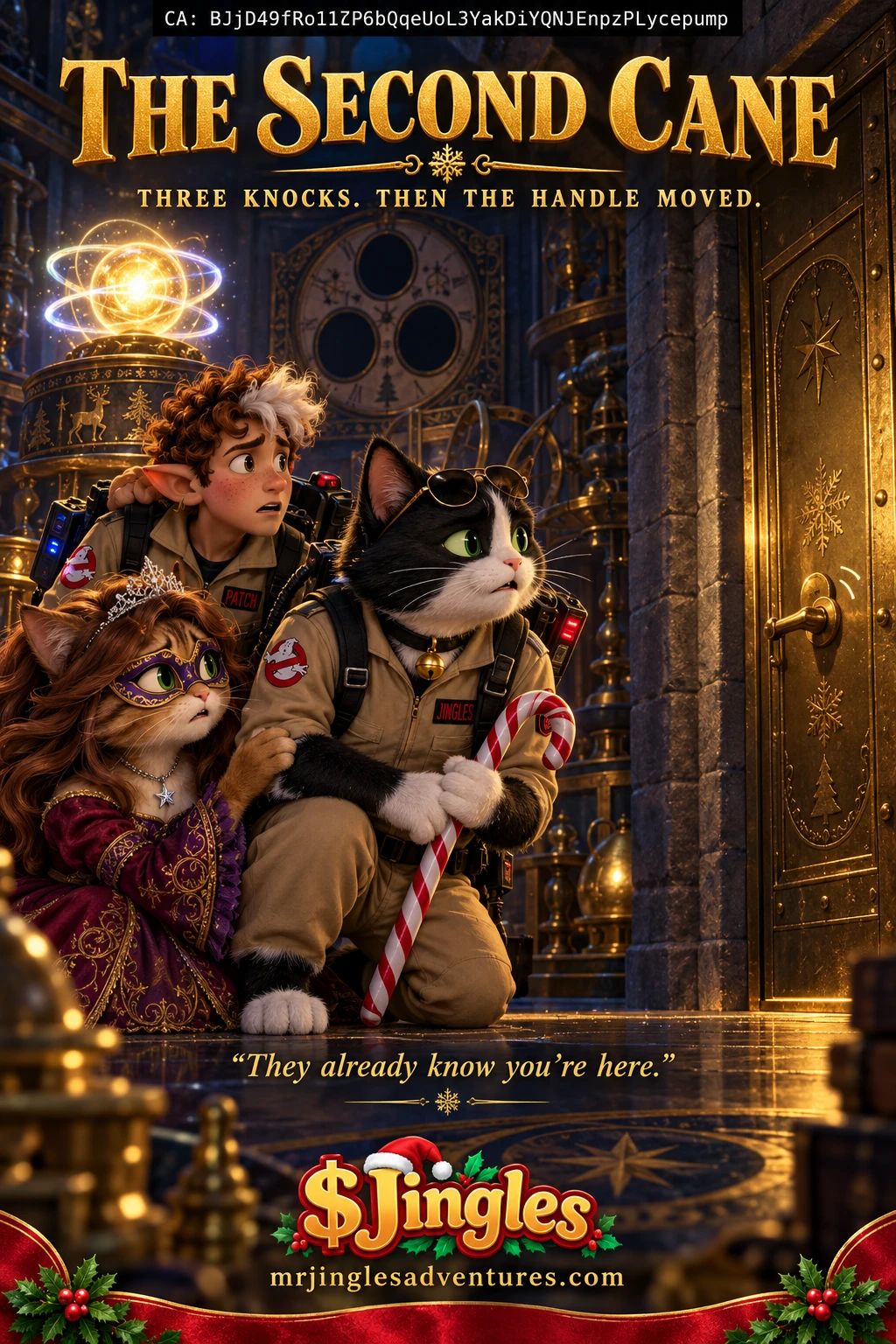
“…they already know you’re here.”
Both candy canes went dark.
Tinsel’s pendant cooled against her paw.
The windows in the clock flickered once.
Then the images vanished.
For several seconds, only the Starfall Core lit the room.
Jingles could see Patch beside him.
Tinsel stood on his other side.
Without discussing it, the three had moved closer together.
Somewhere far away, beyond the office and the service corridor, the party music continued.
A familiar tune.
Laughter.
Someone applauding.
Patch swallowed.
“Was that,” he asked quietly, “part of the recording?”
Jingles listened.
Nothing.
Then, from a narrow brass door set into the vault’s inner wall, came a knock.
Three slow taps.
Tinsel caught Jingles’s sleeve.
Patch stared at the door.
The handle moved.
To be continued.