Borrowed Time
A Mr. Jingles adventure · Illustrated story
“I made it,” Rowan said.
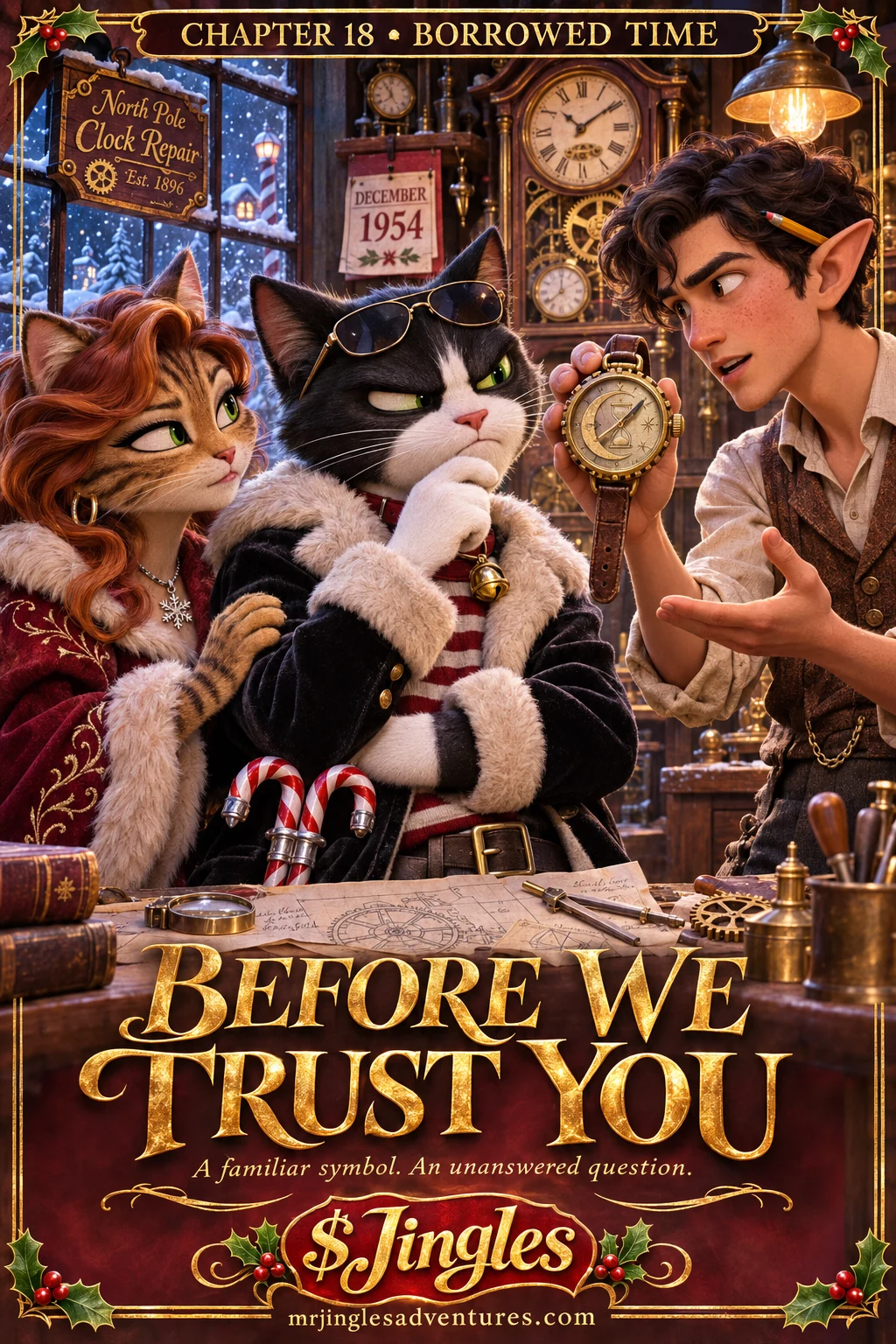
Jingles stared at the instrument on his wrist.
The little brass pointer trembled beneath its glass. Around it, an hourglass rested inside a crescent moon.
Whole.
Unbroken.
Seventy years too early.
“Is something wrong?” Rowan asked.
Jingles opened his mouth.
Tinsel touched his arm.
“We’ve seen that symbol before,” she said.
Rowan glanced down.
“I thought it was rather good.”
“Where?” Jingles asked.
“On the instrument.”
“No. Where did you get the idea?”
Rowan’s smile faded.
“Would you like the coupling repaired,” he asked, “or would you like to argue about my drawing?”
For a moment, Jingles wanted to do both.
Then he thought of Patch.
“The coupling,” he said.
Rowan returned to his shop for a tool bag.
Jingles waited until the door shut behind him.
“That’s his,” he whispered.
“We know he made it,” Tinsel replied.
“The thief had one.”
“Seventy years from now.”
Jingles looked at the shop window.
Inside, Rowan was searching beneath a pile of clock faces.
“People can keep things,” Tinsel said. “Sell them. Lose them. Have them stolen.”
“Or keep using them.”
“Yes,” she replied. “They can.”
She hadn’t dismissed it.
That made Jingles feel a little better.
And considerably worse.
“We watch,” Tinsel said. “We ask careful questions. And we remember why we’re here.”
Jingles rested a paw against the covered machine.
“Patch.”
Rowan came back carrying a canvas bag that clinked with every step.
He noticed Jingles looking at his wrist.
“It finds a matched mechanism,” Rowan explained. “Or it will, once I persuade it to stop finding the tram.”
“The tram?” Tinsel asked.
“Same kind of regulator. Very inconvenient during experiments.”
He held the instrument near the machine.
Its pointer swung toward the brass housing.
“There. Northwind parts are made in sets. A little movement in one can produce an answering movement in another.”
“Like the canes,” Jingles murmured.
Rowan looked up.
“What canes?”
“Family things,” Tinsel said.
Rowan waited.
Neither of them added anything.
At last, he crouched beside the broken coupling.
“Your friend has fitted a return anchor,” he said. “But there’s no departure record for this date.”
Jingles’s paw tightened on the canvas.
Rowan checked a second dial.
Then he stopped moving.
Slowly, he looked at them.
“How far?”
Tinsel glanced at Jingles.
He nodded.
“Seventy-two years,” she said.
A clock struck somewhere inside the shop.
Rowan missed every chime.
Then his eyes shone.
“It worked?”
“Not quite as intended,” Tinsel replied.
“But it worked.”
“Our friend is trapped,” Jingles said.
Rowan’s excitement faltered.
“In your time?”
“Yes.”
“And this is your way back?”
“Our only one.”
Rowan carefully closed the inspection panel.
“Then,” he said, “we’d better get the right part.”
Northwind Clockworks looked even larger from its front steps.
Above the entrance, its enormous clock counted out a perfectly ordinary afternoon.
Jingles found that unsettling.
He was used to Northwind looking like a place everyone had agreed to forget.
Here, an elf was polishing the brass letters beside the door.
Another was arguing with a delivery driver about six crates of incorrect screws.
“Smile,” Rowan whispered.
“I am smiling,” Jingles replied.
“You look as though you’ve swallowed a key.”
“Would that help us get in?”
“Please don’t.”
At the entrance desk, Rowan put down his tool bag.
“Stores and experimental workshop,” he told the clerk. “Replacement coupling.”
The clerk looked past him.
“And these two?”
“Helping me.”
“With what?”
“Repairs.”
Jingles nodded.
“I’ve opened several things that needed repairing afterward.”
Tinsel stepped gently on his boot.
The clerk sighed and pushed three visitor badges across the desk.
“Don’t touch anything with a red label.”
They walked on.
Jingles leaned toward Rowan.
“What about orange?”
“Especially orange.”

Inside, Northwind was full of sounds.
Tiny hammers.
Spinning wheels.
A kettle whistling somewhere behind a partition.
Through an open doorway, a mechanical bird hopped along a brass rail.
It sang three bright notes.
Jingles stopped.
Patch’s little tin robin had sung those notes.
For a moment, he could almost see his friend at the kitchen table, bent over a broken toy.
Tinsel paused beside him.
Then Rowan called softly from ahead.
“This way.”
Jingles followed.
The experimental workshop smelled of warm metal and machine oil.
Rowan unlocked a parts cabinet and began comparing fittings.
“Two mounting holes,” he murmured. “Narrow collar. Left-hand thread.”
Jingles examined a nearby device with six levers and a red label.
Tinsel moved him away from it.
“I was reading.”
“You were reaching.”
“Very educationally.”
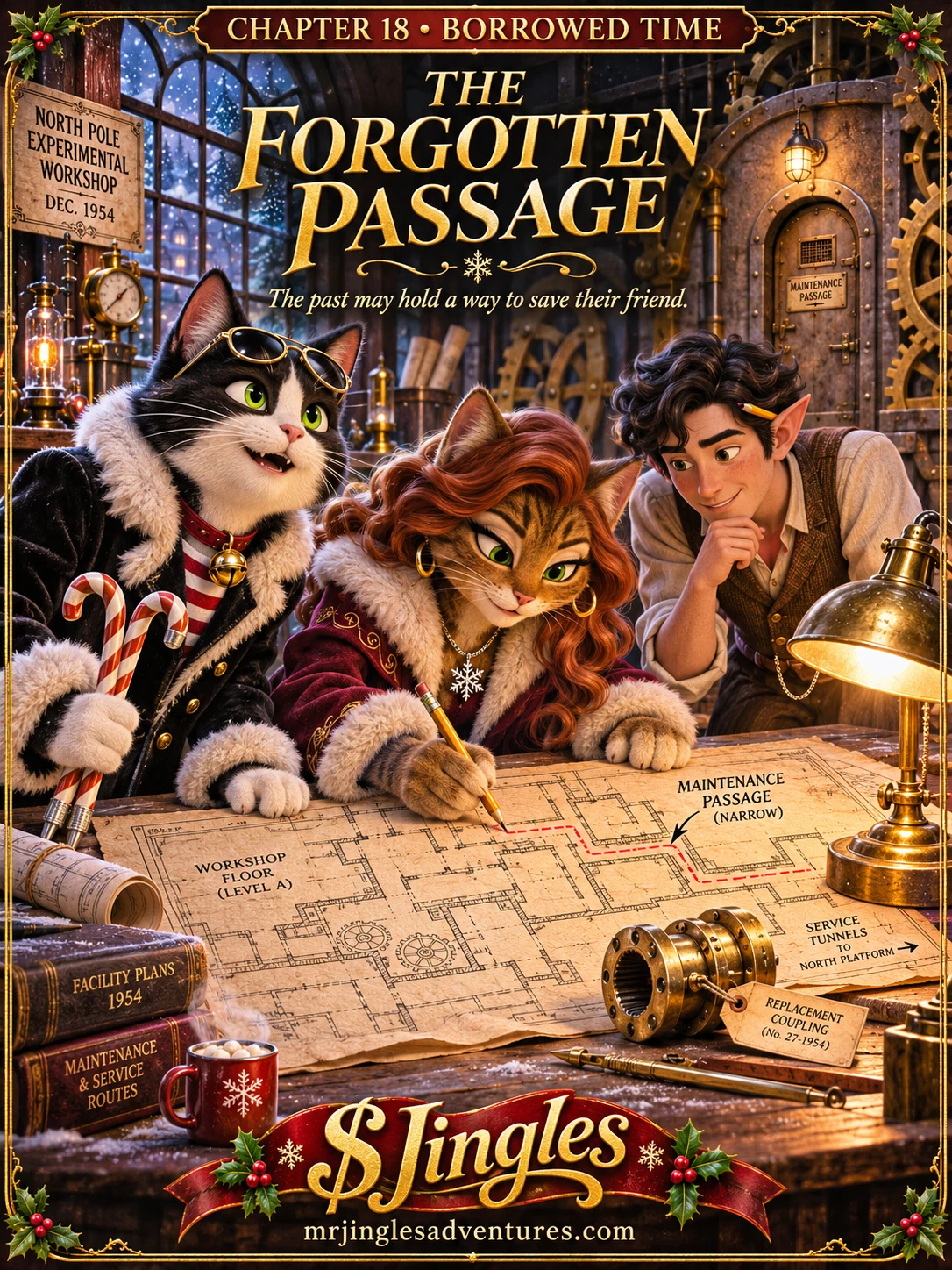
On the wall behind the bench hung a plan of the building.
Tinsel stopped beneath it.
Then she stepped closer.
“Jingles.”
He heard something in her voice and came at once.
The office was in the right place.
So was the main stairwell.
But behind the lower workshop, a narrow line ran around the edge of the building and climbed toward the rooms above.
A passage.
It wasn’t on the drawings they had studied at Patch’s apartment.
Tinsel traced it without touching the paper.
“Where does this go?”
“Maintenance stair,” Rowan said. “For servicing the wall drives.”
He pointed with the coupling.
“Entrance beside the old gear press. Up two flights. Hatch behind the instrument room.”
Jingles stared at the tiny square marking the hatch.
The instrument room.
Where Patch had been left behind.
Or where it would stand, seventy-two years from now.
“Is it locked?” Tinsel asked.
“From the inside. Why?”
“We got lost earlier,” Jingles said.
Rowan looked at him.
“You’ve been here six minutes.”
“I work quickly.”
Tinsel asked for a scrap of paper.
Rowan handed her one.
While he tested the replacement fitting, she copied the passage, the stair, and the position of the hatch.
Jingles watched the pencil move.
They had come looking for a way home.
Here was something they hadn’t dared hope for.
A way in.
“Could it still be there?” he whispered.
Tinsel kept drawing.
“It might.”
“And if it is?”
She marked the hatch with a small cross.
“We won’t have to use his front door.”
Across the room, Rowan fitted the coupling into a measuring jig.
Click.
A clean, satisfying sound.
“This one,” he said.
Jingles looked from the brass part to Tinsel’s drawing.
For the first time since the barrier had closed on Patch, getting him back felt like something they could actually do.
Before they left, Rowan took them past the gear press.
A narrow arched door stood behind it.
Its handle was worn smooth.
Tinsel studied the hinges.
Jingles counted the windows above.
Then they followed Rowan outside.
Neither of them noticed the snow until it touched their faces.
Back in the alley, Rowan worked with his sleeves rolled above his elbows.
He removed the broken coupling.
Cleaned the shaft.
Slid the replacement into place.
Jingles offered him a screwdriver.
“Smaller,” Rowan said.
Jingles offered another.
“Larger than that.”
“There seems to be a troubling gap in my expertise.”
“Hold the lamp.”
“That I can do.”
Tinsel kept Patch’s notebook open beside the machine.
She checked each step against the cramped handwriting.
When Rowan reached for the anchor dial, she caught his sleeve.
“Leave that.”
“I was only going to—”
“Leave it.”
Rowan looked at her paw.
Then at the green light.
He withdrew his hand.
“All right.”
Tinsel let go.
After a moment, Rowan said, “You trust the friend who built this.”
“Yes,” she replied.
“I’d like to meet him.”
Jingles held the lamp a little steadier.
“So would I,” he said.
By the time Rowan tightened the last screw, evening had settled over the alley.
The machine’s rings turned without scraping.
The broken shudder was gone.
Inside its housing, the Starfall Core glimmered.
Jingles climbed onto the footplate.
“Ready?”
“Not yet,” Tinsel said.
His ears lowered.
“We’ve fixed it.”
“We’ve replaced a part.”
Rowan nodded.
“She’s right.”
Jingles looked between them.
“I preferred it when you were suspicious of each other.”
Tinsel opened the notebook.
Patch had underlined a line near the bottom of the page.
TEST RETURN SIGNAL BEFORE FULL POWER.
Below it, in smaller letters:
Especially if Jingles says it looks fine.
Jingles stared at it.
“That seems unnecessary.”
Tinsel gave him a look.
“All right,” he said. “Slightly necessary.”
Rowan connected the machine’s little speaker.
“A signal takes much less power than a crossing,” he explained. “We send it along the return anchor. If it answers from the right place and time, we’ll hear it.”
“And if it doesn’t?” Jingles asked.
“We don’t jump.”
Tinsel checked the green light.
Still steady.
Rowan turned the test dial.
The speaker crackled.
A thin note rose and disappeared.
Then came a faint, uneven tapping.
Jingles bent closer.
“Is that our apartment?”
Rowan frowned at a small needle.
“No. Something else is answering.”
Tinsel’s paw went to the breaker.
“Turn it off.”
“Wait,” Jingles said.
Three notes sounded through the static.
The first was clear.
The second wavered.
The third barely reached them.
Jingles knew them anyway.
The robin.
“Patch?”
The speaker hissed.
Jingles leaned so close that his whiskers brushed its metal grille.
“Patch, can you hear me?”
A sharp click.
Then—
“Jingles?”
Tinsel pressed a paw to her mouth.
Rowan stared at the answering needle.
“Another Northwind mechanism,” he whispered. “It’s caught the signal.”
“Patch, where are you?”
“Still here.” His voice broke into static, then returned. “Instrument room. He left the workshop power on. I heard your test through the panel.”
Jingles gripped the edge of the machine.
“We’re coming.”
“Listen carefully,” Patch said. “I can’t keep this connected.”
Tinsel bent toward the speaker.
“We found a way back.”
For a heartbeat, there was only the hiss.
Then Patch answered.
“Good.”
Somewhere behind his voice, a lock clicked.
“Because he’s waiting in your apartment.”

To be continued…