The Longest Day
A Mr. Jingles adventure · Patch’s Halloween · Illustrated story
Patch had never put uneaten waffles in the refrigerator before.
He stood holding the plate, uncertain where they belonged.
Behind him, Jingles watched from the table.
“Perhaps leave them a forwarding address.”
Patch managed a small smile.
Santa had given the workshop staff the day off before the Halloween celebration. No repair shifts. No deliveries. No bells telling anybody where to be.
Patch had looked forward to it all week.
Now he would have welcomed a broken train and somebody telling him to fix it.
Instead, there was a whole day between breakfast and the party.
He checked the list beside the drawings.
Felt. Spare bulbs. Sturdy ribbon.
He checked it again.
“I need a few things from town.”
Jingles nodded.
“And some air?”
“Possibly a great deal of air.”
Patch put on his coat.
At the door, he looked back.
Jingles was gathering the drawings into their folder.
“Don’t practise on anything important while I’m gone.”
Jingles glanced at the candy cane.
“What counts as important?”
“Anything with an owner.”
“A surprisingly broad category.”
Patch shut the door before he could think of a reply.

The North Pole was making a cheerful mess of Halloween.
Paper bats hung between Christmas bells. A row of snowmen outside the post office wore pointed black hats. Someone had draped a white sheet over a reindeer statue, leaving the antlers poking through.
At the bakery, the pumpkin in the knitted scarf had acquired a pair of earmuffs.
Patch stopped beside it.
“You look more prepared than I feel.”
The pumpkin offered no advice.
A little farther along, two elves were carrying a coffin-shaped cake toward the square. Every few steps, one lifted the lid to check the icing.
“Stop looking,” the other complained. “You’re letting the spooky out.”
Patch laughed.
For a moment, his shoulders loosened.
This was the town he knew: warm windows, ridiculous arguments, people who could disagree for an hour about the correct expression on a gingerbread face.
By tonight, he and Jingles might be hiding from some of those same people inside Santa’s workshop.
He pushed his hands deeper into his pockets.
They weren’t taking presents.
They weren’t going to hurt anyone.
They were going to bring the Core back.
He had said those things so often that they should have made him feel better.
They helped.
Not quite enough.
The bell above the haberdashery door gave a familiar little jangle.
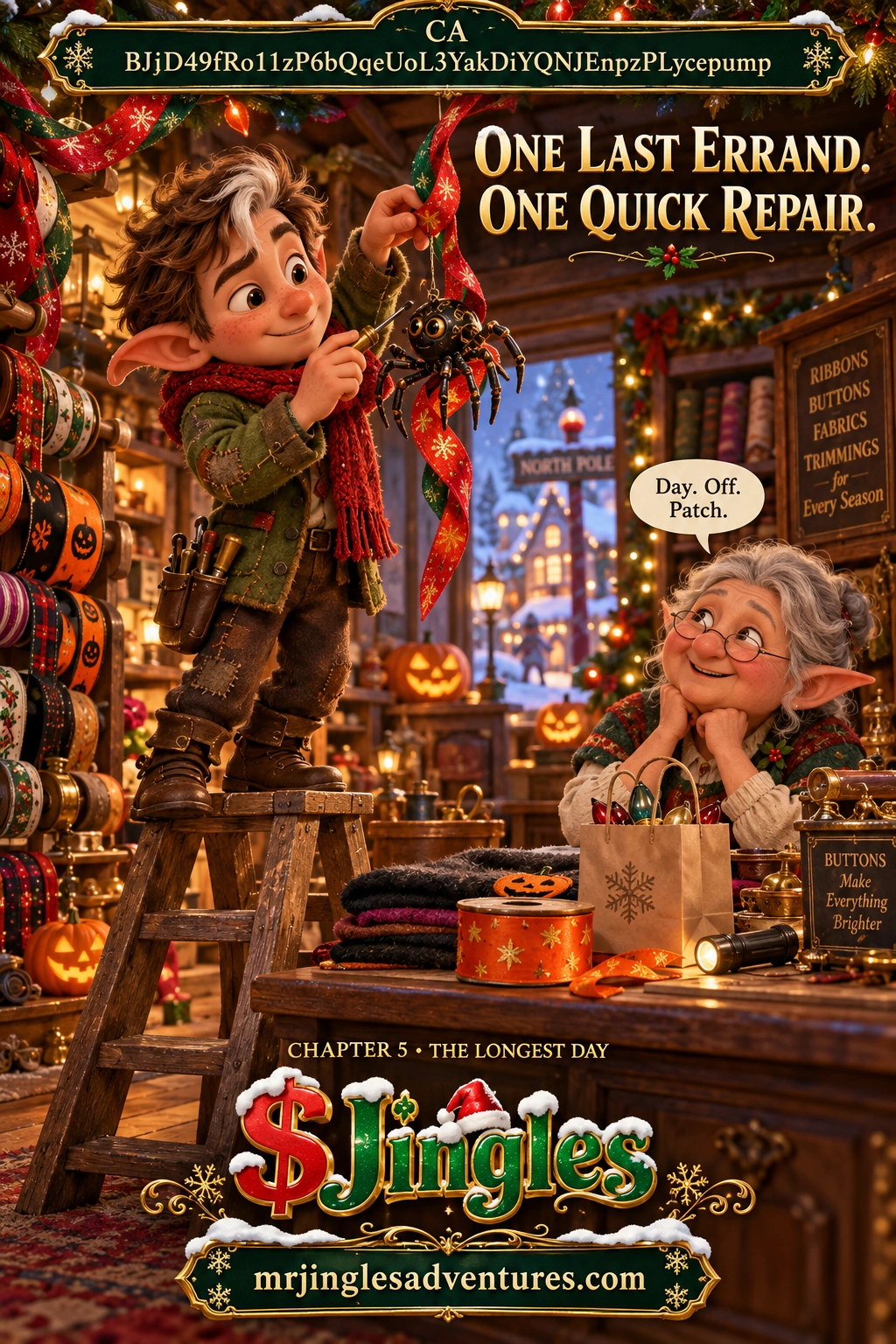
Inside, ribbons hung in bright loops from wooden pegs. Baskets of buttons crowded the counter. A mechanical spider lowered itself from the ceiling, became tangled in a Christmas streamer, and stopped.
The shopkeeper sighed.
“That’s the third customer it’s failed to frighten.”
Patch looked up.
“I could loosen the—”
“Day off, Patch.”
“Only the little—”
“Day. Off.”
He lowered his hand.
“Right.”
“What can I get you?”
“Dark felt. And strong ribbon.”
“Finishing your costume?”
“Yes.”
That answer, at least, required no invention.
Their costumes needed a few final repairs. Patch also wanted to line the little carrying pouch he had prepared for the Core. The felt would cushion its outer casing on the walk home. It would do nothing to contain its power; that was what the three crystal rings were for.
He had checked those measurements six times.
He might check them again.
The shopkeeper set two ribbons on the counter.
“One’s stronger. One’s prettier.”
“Stronger.”
“Good choice.”
Patch hesitated.
“Could I have a little of the prettier one too?”
The shopkeeper smiled.
“Halloween?”
Patch looked at the orange ribbon.
It had tiny gold stars along its edge.
“Halloween.”
As she wrapped his purchases, he watched the spider turn very slowly inside its streamer.
“Would you mind if I—”
She slid a small stepladder toward him.
“Quickly.”
Five minutes later, the spider descended properly.
The shopkeeper gave a satisfactory shriek.
Patch left feeling, briefly, like himself.
At the hardware shop, he bought two spare bulbs for the machine’s control panel and a fresh battery for his little torch.
He chose the bulbs from the drawer himself.
The owner watched him compare their markings.
“Big project?”
“Something I’d rather not have go dark.”
“My advice exactly.”
Patch counted out his coins.
Beside the till stood a display of torches shaped like ghosts. Their eyes flashed when someone pressed their noses.
He tried one.
It made a noise like a goose falling down stairs.
Patch put it back.
Discretion, he decided, was worth paying for.
He tested his own torch before leaving. A steady beam fell across his palm.
One less thing to worry about.
Outside, he crossed it off his list.
Then he checked the list to make certain he had crossed off the correct thing.
By noon, his errands were finished.
He could have gone home.
Instead, Patch took the longer road beside the old toy shops.
The party would begin that evening whether he hurried or not. For once, there was nothing useful he could do to the clock.
A small window near the corner caught his eye.
SECONDHAND TOYS — ANOTHER CHANCE TO PLAY.
He knew the shop. He had bought spare wheels there, and once a box of gears that had turned out to contain mostly shirt buttons.
Today, an old tin robin stood in the window.
Its red breast had faded almost to pink.
One wing sat slightly lower than the other.
Patch stopped.
He knew that shape.
Not this particular bird. But one just like it.
He had been small enough for his feet to swing above the floor.
That was the first thing he remembered.
The kitchen chair in his foster home had been much too tall. Someone had tucked a cushion behind his back, but his boots still couldn’t reach the tiles.
On the table stood a tin robin.
A toy passed along by somebody whose name he no longer remembered.
Its wing was bent. Its key would only turn halfway.
Patch had loved it immediately.
He had spent an entire afternoon trying to mend it with a spoon, a piece of thread, and very little understanding of what any of them were supposed to do.
His foster mother had found him asleep beside it.
The robin had been wrapped in a strip of cloth.
“What’s happened here?” she had asked when he woke.
Patch had rubbed his eyes.
“He needed a patch.”
She had smiled.
“So I see.”
He could remember that smile.
He could remember the warm kitchen and the bird beneath his hands.
But he could not remember the first time his own mother had smiled at him.
He had tried.
For years, he had tried.
The shop door opened beside him.
“Something in the window?”
Patch blinked.
The old shopkeeper stood holding a broom.
“The robin,” Patch said.
“Still sings. Wing’s a bit troublesome.”
“May I?”
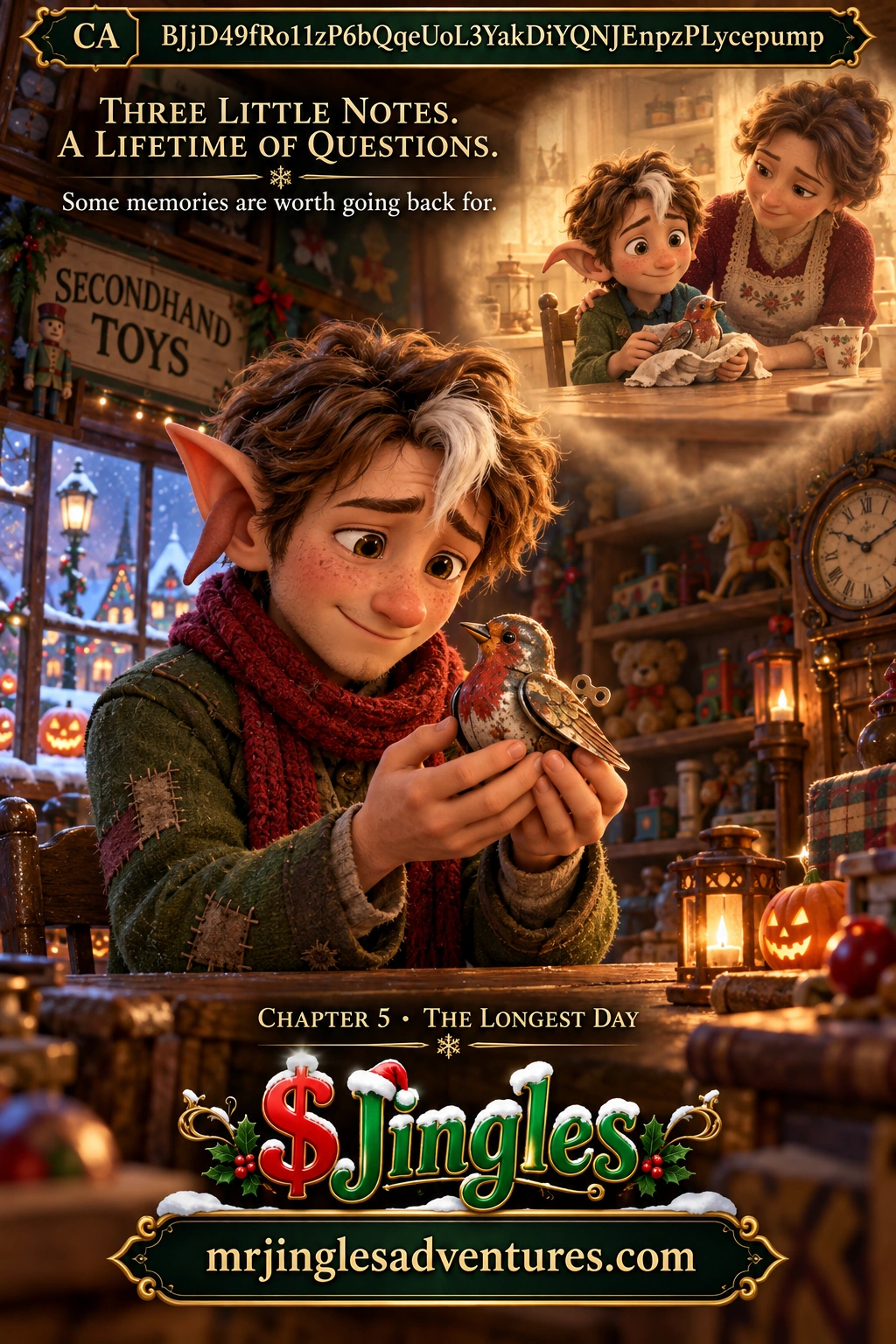
Inside, the bird fitted neatly into his palm.
He turned the key.
Three thin, bright notes rose from its little metal throat.
Patch sat down.
He hadn’t meant to.
The shopkeeper said nothing.
Patch wound the key once more.
The same three notes.
Suddenly he could see the foster-home kitchen so clearly that he almost expected to smell its porridge.
He had been looked after there.
He had known kindness.
Wanting to find his parents didn’t make any of that smaller.
But there was an empty space before that kitchen. Before the high chair and the cushion. Before the bent-wing bird.
He wanted to know who had held him then.
Whether they had looked for him.
Whether somebody, somewhere, had kept waiting.
The shopkeeper shifted the broom.
“For a child?”
Patch stroked one thumb over the robin’s faded breast.
“For someone who used to be.”
He bought it.
He ate lunch on a bench near the square.
A sandwich first.
Then a small bag of sugared almonds.
When he reached for a third handful, he paused.
His appetite appeared to be returning.
Not a complete recovery, perhaps. But enough to count.
Beside him, the robin stood on its paper wrapping.
Patch straightened its bent wing carefully with his fingertips. The metal needed proper attention at home. He would do it after—
He stopped.
After tonight.
There would be a tomorrow, whatever happened at the party.
He needed to remember that.
He tucked the bird safely into his bag.
He still wanted to go through with the plan.
More than ever, now.
But he wanted to come home from it too.
The afternoon passed in small interruptions.
An elf outside the post office needed someone to hold a ladder. A little girl dropped a toy horse in the slush, and Patch helped clean its wheels. At the square, he stopped to watch a group of children practise a dance for the party.
They were meant to be bats.
One insisted on being a potato.
Nobody had found a satisfactory compromise.
Each time Patch started home, something ordinary held him a little longer.
By the time he finally turned toward the repair shop, the afternoon light had thinned. The first evening lamps glowed above the street.
His hands were cold.
His bag was full.
And the party was no longer something happening much later.

Upstairs, Patch pushed open the apartment door.
“Jingles?”
No answer.
He set the bag on the kitchen table.
The breakfast plates were washed. The drawings had been put away. Their costume bags still hung where they had left them.
“Got the felt,” Patch called.
“And the bulbs.”
The apartment remained quiet.
He checked the back room.
The time machine waited in its faint blue standby glow. The empty Core cradle sat untouched.
No Jingles.
Patch returned to the kitchen.
Perhaps he had gone for a biscuit.
Perhaps he had met Tinsel again.
That second thought made Patch glance at the clock.
He unpacked the ribbon, the bulbs, and the little torch.
Last came the tin robin.
He placed it beside the table lamp and turned its key.
Three bright notes sounded in the empty room.
Patch looked toward the door.
“Where have you gone?”
Outside, laughter drifted up from the street as the first costumed partygoers headed toward Santa’s workshop.
Patch stayed beside the table.
This time, he listened for footsteps.
To be continued.